Agent Requests: Building AI Agents That Know When To Ask
An AI agent is on a phone call, working through a billing case. To close it, it needs an exception code that only one senior person on the team knows. The agent has three options: guess, leave the customer on hold, or do what a good operator would do: tell the customer it will call back, ask the colleague who knows, and return with the answer.
Every agent running a real process hits moments like this: a refund that’s a little too large, a detail it can’t verify, an edge case nobody wrote a rule for.
These aren’t failures of the agent. They’re the points where a process genuinely requires human judgment, and they exist in every customer care operation.
The missing middle
Most platforms handle these moments badly. You get two options: full autonomy, where the agent decides on its own and you hope it got it right; or full takeover, where a person absorbs the entire conversation and the automation is gone, along with most of its value, since the human now has to rebuild the context and carry the case to the end.
What teams want is the part in the middle: the agent does the work, and a human makes the one decision that needs one.
That’s what Agent Requests are for. At any point in a process, a Yampa agent can stop, route a question to a specific person, wait for the answer, and act on it. The agent keeps ownership of the process end to end. The human contributes the judgment call.
Two conversations, one mechanism
Back to that billing call. The agent doesn’t guess and doesn’t stall. It tells the customer it will call back, ends the call, and sends a request to the senior teammate, who answers when they can. The moment the answer comes in, the agent calls the customer back and closes the case. For the customer: one call, one promise, one callback that actually happens.
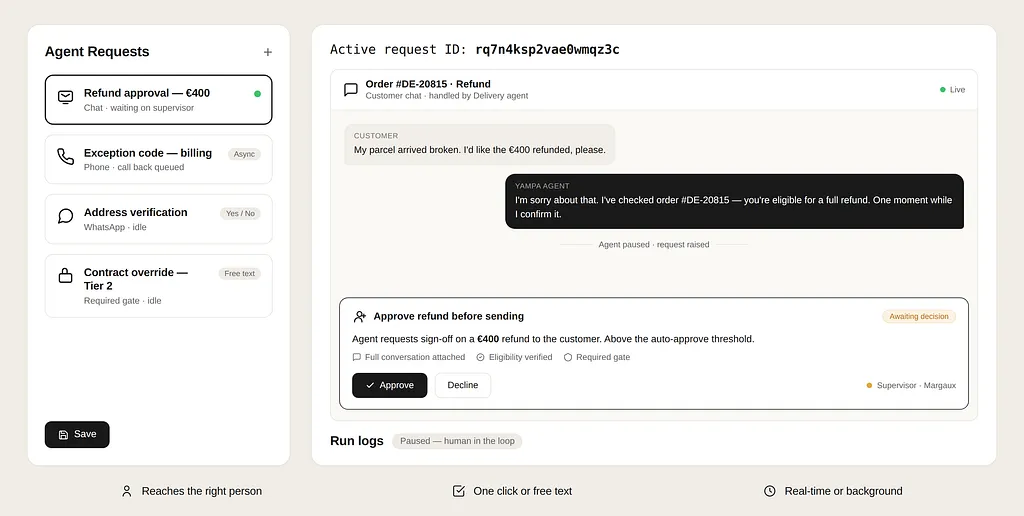
Now a different shape of the same idea. A customer on chat asks for a €400 refund. Your policy says refunds above €200 require approval (the same control you’d impose on a junior operator). The agent checks the order, confirms eligibility, and raises a request to a supervisor. The supervisor sees the full conversation, approves in one click, and the agent completes the refund in the same chat. The customer never knows a second person was involved; the supervisor spent ten seconds on the only part that needed them.
The difference between the two is timing. In the chat case, the request is synchronous: the agent holds the conversation and waits. In the phone case, it runs in the background: the agent steps away and re-engages once it has what it needs.
The details that make it work
- Requests reach experts where they already work. In the Requests interface on the Yampa platform, or on any channel your team already uses: Microsoft Teams, WhatsApp, even a phone call from the agent itself. Nobody learns a new tool to answer a question.
- The format fits the question. Some decisions are a yes or a no, so the request is a single click. Others need real expertise written back, so they’re free text. You choose based on what you need from the human.
- Requests are agent-initiated, or enforced by you. The agent can raise a request whenever it judges a human is needed. You can also make one mandatory, with a hard gate before anything sensitive, like issuing a refund above a threshold. Used that way, a request becomes a guardrail you control.
- Context travels with the question. The person answering sees the conversation, the customer, and what the agent is about to do. A decision that would have taken a ten-minute handover takes seconds.
Humans at the center
Running an AI agent workforce only works if humans stay at the center of it: not reviewing from the outside, not taking over when the agent gives up, but making the calls only they should make, while the work is still in motion.
Your best AI agents won’t be the ones that never need a human. They’ll be the ones that know exactly when they do.